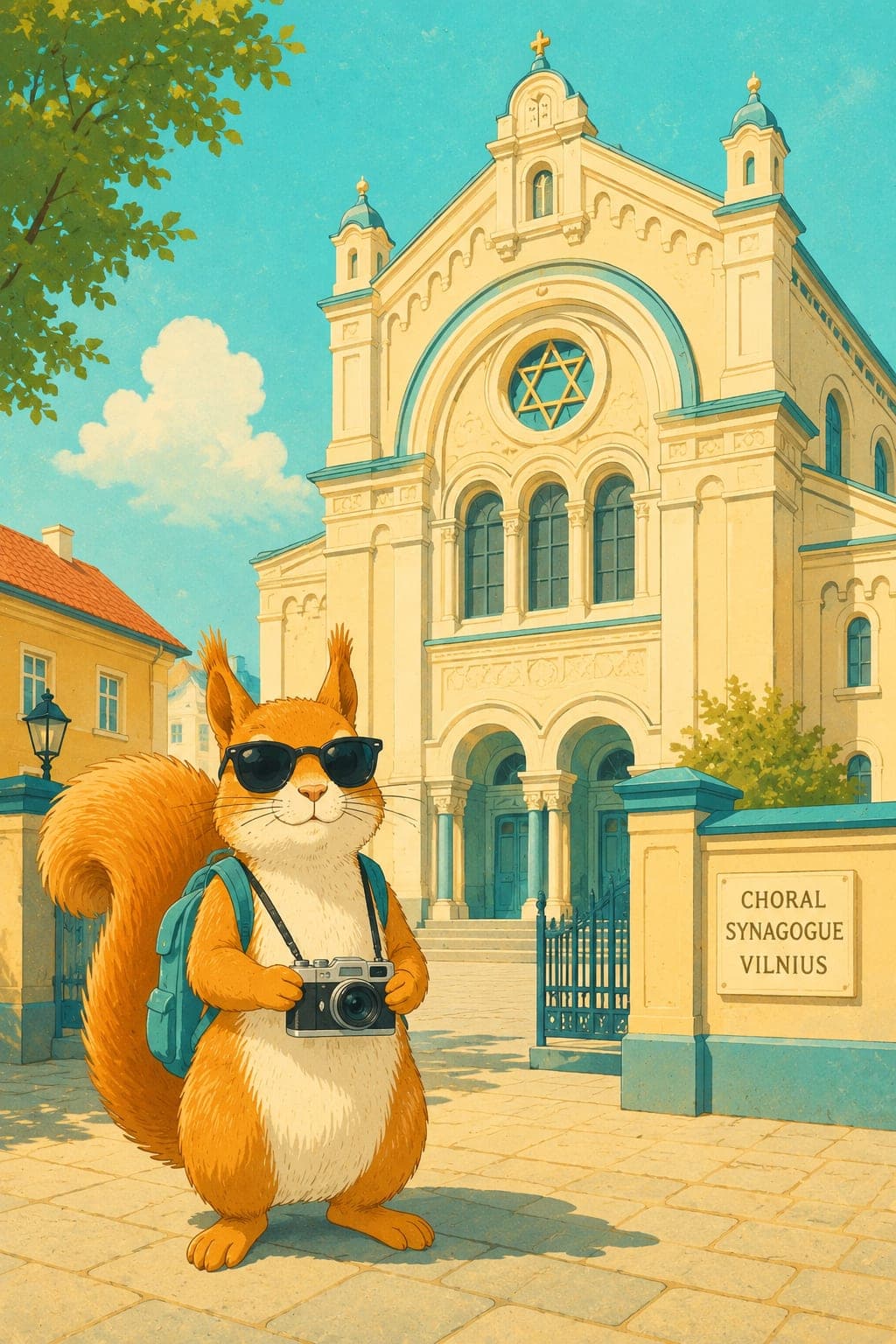
Why Lithuania matters to Jewish history
Jews from the lands of the old Grand Duchy of Lithuania are known as Litvaks, and their tradition of scholarship shaped Jewish life far beyond the region. Its best-known figure is Elijah ben Solomon Zalman, the Vilna Gaon (1720 to 1797), the Talmudic scholar whose name the city's Jewish museum carries today.
The US Holocaust Memorial Museum gives the scale of what was lost. Before the Second World War about 160,000 Jews lived in Lithuania, around 7 percent of the population. By 1941, with refugees from German-occupied Poland, the number had reached about 250,000. During the Holocaust about 90 percent of Lithuanian Jews were murdered, one of the highest victim rates in Europe.
That is the frame for a visit. Much of what you see is memory rather than living community, but there is a working synagogue in Vilnius, a Jewish community that still meets there, and serious museums that tell the whole story, the centuries of life as well as its destruction.
Vilnius: the old Jewish quarter, the synagogue and the museums
The old Jewish quarter lies in the Old Town around Žydų (Jewish), Stiklių, Gaono and Mėsinių streets. A monument to the Vilna Gaon stands on Žydų Street, on the site of the house where he lived. In September 1941 the German occupiers forced the city's Jews into two ghettos here: the small ghetto around Stiklių, Gaono, Antokolskio and Žydų streets, and the large ghetto around Rūdninkų, Mėsinių, Ašmenos and Ligoninės streets. A plaque near the former main gate on Rūdninkų Street shows the plan of both. The large ghetto was liquidated in September 1943.
The Choral Synagogue at Pylimo 39, completed in 1903, is the only one left in Vilnius of the more than a hundred that stood before the war, and it is still a place of prayer. Visitors are received Monday to Friday, 10:00 to 15:00. It is closed to visits at weekends.
The Vilna Gaon Museum of Jewish History has several branches, and in Vilnius they are closed on Mondays. The Museum of Culture and Identity of Lithuanian Jews, at Pylimo 4A in the former Tarbut Hebrew gymnasium, covers religion, shtetl life, language and culture. The Holocaust Exhibition at Pamėnkalnio 12 covers the destruction. Both open Tuesday to Friday 10:00 to 18:00 and at weekends 11:00 to 18:00, and close on public holidays. The Samuel Bak Museum at Naugarduko 10/2, devoted to the painter born in Vilnius in 1933 who survived the Nazi occupation as a child, is another branch.
A guided walk through the quarter, the synagogue and one museum fills a full day without rushing. Our one day in Vilnius guide covers the rest of the Old Town if you have time either side.
Paneriai (Ponary): the memorial outside the city
Paneriai is a forest on the south-western edge of Vilnius. From July 1941 German Einsatzgruppen and their Lithuanian auxiliaries shot the Jews of Vilna there; by the end of 1941 about 40,000 Jews had been killed. The US Holocaust Memorial Museum says that by July 1944 perhaps as many as 75,000 people had been killed at the site, the vast majority of them Jews. Poles, Soviet prisoners of war, Roma and others were also murdered there, and the memorial has monuments to each group.
The memorial grounds at Memorialo 15 are open at any hour and free. The small information centre is part of the Vilna Gaon Museum: closed Mondays and Saturdays, open Tuesday to Thursday 9:00 to 17:00 and Friday and Sunday 9:00 to 16:00, and from October to May only by request. Guided visits are booked in advance through the museum.
It is within walking distance of Paneriai railway station, but most visitors come by car with a guide, which also makes it easy to pair with the Holocaust Exhibition the same day. Allow time afterwards. It is not a place to hurry away from.
Kaunas: Sugihara House, the Ninth Fort and Vilijampolė
Sugihara House at Vaižganto 30 was the Japanese consulate where, in the summer of 1940, consul Chiune Sugihara issued transit visas through Japan to Jewish refugees, most of them from Poland. The museum also remembers Jan Zwartendijk and the other diplomats whose papers opened that route. It opens Monday to Friday, 11:00 to 16:00. At weekends it receives only groups of five or more, booked ahead.
The Ninth Fort, at Žemaičių plentas 73 on the northern edge of the city, is one of the forts of the old Kaunas fortress, and it became the place where thousands of Jews from the Kaunas ghetto were murdered. On 28 and 29 October 1941, in what became known as the Great Action, more than 9,200 Jews were selected and murdered there, nearly 4,300 of them children. Jews deported from abroad, including from Germany and Austria, were also killed at the fort. The museum is closed on Mondays. Inside the exhibitions, guided visits are given only by museum staff or accredited guides with the museum's permit.
The Kaunas ghetto was set up in August 1941 in Vilijampolė, known in Yiddish as Slobodka, across the Neris from the Old Town and long the heart of the city's Jewish community. Today it is an ordinary residential district, and it is best walked with a guide who can show where the ghetto stood.
The shtetls: small towns where heritage can be visited
Most Jewish life in Lithuania was lived in small market towns, and a few have restored what survives. In Kėdainiai, on the Old Market Square, a summer and a winter synagogue stand side by side; the winter synagogue has housed a multicultural centre since 2002, with a small exhibition on the town's Jewish community and the Holocaust.
In Joniškis, in the north, the White (summer) and Red (winter) synagogues on the main square have been restored. The Red Synagogue holds an exhibition on the history and culture of the Jews of the Joniškis area, with its Torah ark and painted ceiling restored. In Telšiai, the building of the Telz yeshiva, one of the best-known Lithuanian yeshivas, reopened in 2023 with a branch of the Alka Museum inside it.
Near Plungė, the Kaušėnai memorial marks where the town's Jews were killed in 1941. Its wooden sculptures were made by Jakovas Bunka (1923 to 2014), a Jewish folk artist who called himself the last Jew of Plungė and spent decades preserving the community's memory. In Šeduva, the Lost Shtetl Museum opened in September 2025 and tells the story of one shtetl through photographs, records and descendants' testimony; it is closed on Mondays. Seeing it before your own family's town helps you understand what you are looking at when you get there.
Researching Litvak family roots
Most surviving Jewish birth, marriage and death registers for present-day Lithuania are in the Lithuanian State Historical Archives (LVIA) in Vilnius, which holds the vital records of religious communities up to 1940. Many have been scanned and can be read free online through the archives' EAIS reading room (eais.archyvai.lt) and the ePaveldas portal (epaveldas.lt).
The catch is that these are scanned books, not a database of names. You generally need to know the town and roughly the years, then read the registers page by page, often in Russian or Hebrew script. For a first look, the free indexes from LitvakSIG and JewishGen are the place to start, because they let you search by surname.
If you know a town name but not much else, send it to us through our roots page and we will reply with a free one-page village report: where the town is, what is there now, and which archive to look in. Full archive research is a separate, paid piece of work, and we quote it openly.
Visiting etiquette and planning the days
Synagogues and Jewish community sites do not receive visitors on Shabbat, and Jewish holidays can close them too. At memorials such as Paneriai and the Ninth Fort, dress modestly, keep voices low and ask your guide before taking photographs of people. Men are usually asked to cover their heads inside the synagogue.
The opening days fit together in a simple pattern. Monday is the hard day: the Vilna Gaon branches, the Ninth Fort and the Lost Shtetl Museum are closed. Weekends close the Choral Synagogue and Sugihara House. So Tuesday to Friday is when everything is open, and a Vilnius day and a Kaunas day both belong there.
If a Monday falls in your trip, the Paneriai grounds and Sugihara House are both open, and so is the Choral Synagogue. A day in a shtetl town can sit between Vilnius and Kaunas or on the way north towards Riga. Heavy days read better followed by a lighter one, and we build our own routes that way.
- What is the Jewish heritage of Lithuania?
- Lithuania was the heartland of the Litvaks, the Jews of the old Grand Duchy of Lithuania, and Vilnius was one of the great centres of Jewish learning, the city of the Vilna Gaon. About 90 percent of Lithuanian Jews were murdered in the Holocaust. Today you can visit the Choral Synagogue, the Vilna Gaon Museum branches, the Paneriai memorial, Sugihara House and the Ninth Fort in Kaunas, and restored synagogues in towns such as Kėdainiai and Joniškis.
- Can you visit Ponary (Paneriai)?
- Yes. The Paneriai memorial is on the edge of Vilnius at Memorialo 15. The grounds are open at any hour and free. The information centre, part of the Vilna Gaon Museum, is closed Mondays and Saturdays and opens from October to May only by request, so book a guided visit ahead.
- When is the Vilnius Choral Synagogue open?
- Monday to Friday, 10:00 to 15:00. It is closed to visitors at weekends. It is the only synagogue left in Vilnius and is still used for prayer.
- Is Sugihara House open at weekends?
- Only for groups of five or more, booked in advance. Otherwise it opens Monday to Friday, 11:00 to 16:00. The Ninth Fort is closed on Mondays, so Tuesday to Friday is the best day for Kaunas if you want both.
- How do I find records of my Litvak ancestors?
- Most surviving Jewish vital records for present-day Lithuania are in the Lithuanian State Historical Archives in Vilnius, many scanned and viewable free at eais.archyvai.lt and epaveldas.lt. They are not searchable by name, so start with the free LitvakSIG and JewishGen indexes. If you only know a town, our free village report on the roots page is a good first step.
- How many days do you need for Jewish heritage in Lithuania?
- Two full days cover the essentials: one in Vilnius with Paneriai, one in Kaunas. A third day adds a shtetl town such as Kėdainiai, Joniškis or Šeduva. Put the Vilnius and Kaunas days between Tuesday and Friday, when every main site is open.
Make this part of your Lithuania trip.
Tell us your dates, interests and the pace you have in mind. We will suggest how this could fit your route.