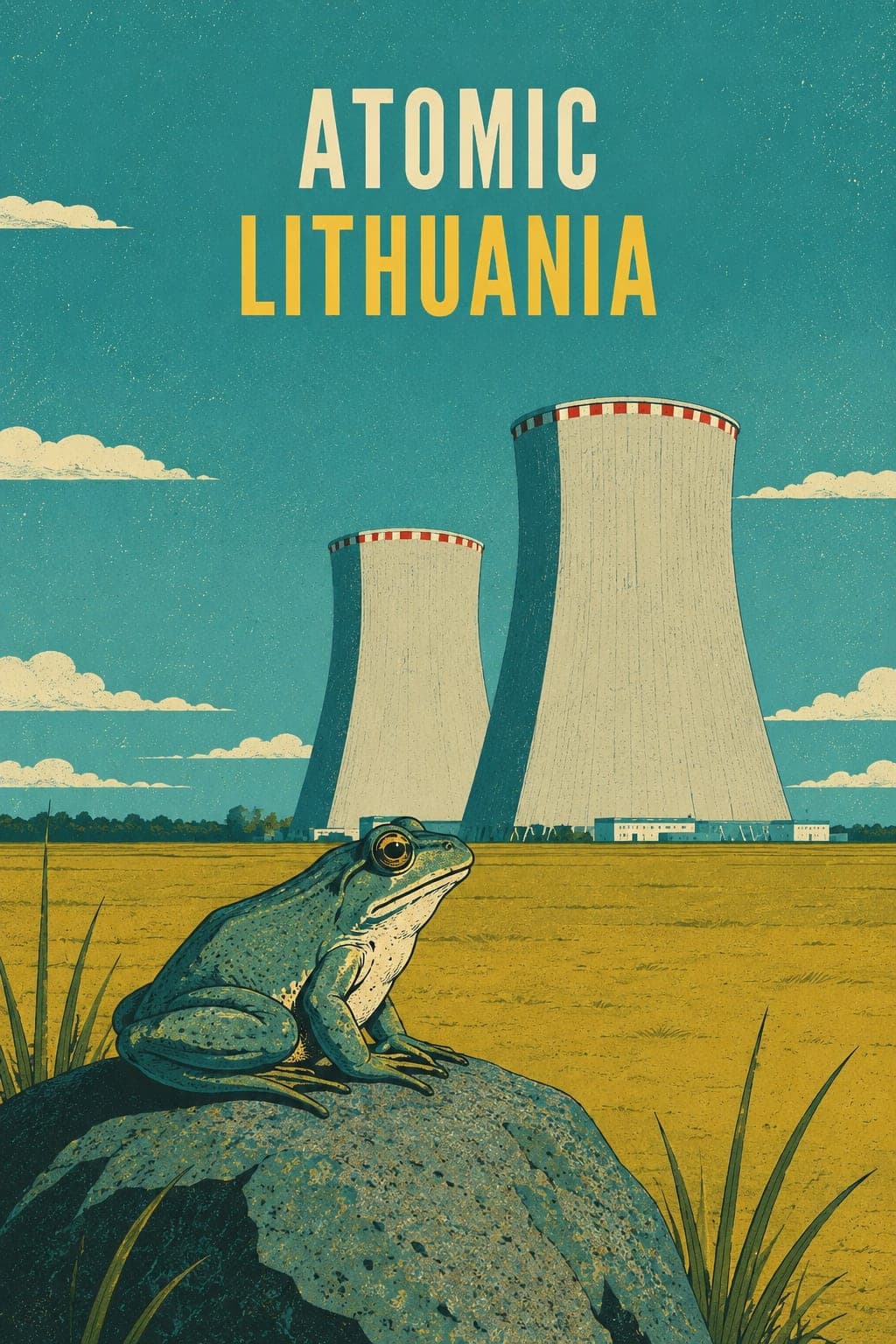
The short answer
Ignalina is open to visitors, by arrangement, and the access on offer is unusually deep for a nuclear site. This is not a fenced viewpoint or a museum with a scale model. The tour goes inside the plant buildings, and the rooms you walk through are the working rooms of a station that generated most of Lithuania's electricity until 2009.
The catch is process, not permission. Every visitor is cleared in advance, which means passport details submitted weeks out, a fixed date you cannot move at short notice, and a guide licensed to escort groups inside. That is the whole reason this is difficult to book on your own from abroad.
Why it looks like Chernobyl, because it very nearly is
Ignalina and Chernobyl were built to the same design: the RBMK-1500 here, the RBMK-1000 in Ukraine. Same reactor family, same Soviet control-room layout, same instrument panels and the same rotary switches. When HBO made Chernobyl in 2019 they filmed the control-room and plant-interior scenes at Ignalina, because it was the closest thing left standing to the real thing.
That is why the footage feels so exact. It is not a set built to resemble a Soviet reactor hall. It is a Soviet reactor hall, with the original panels in place, in a country that happens to be an EU member with good roads and a functioning tourism ministry.
Ignalina was never a disaster site. Nothing went wrong here. It closed because the European Union would not accept an RBMK reactor inside its borders, and Lithuania accepted the condition to join in 2004. Unit 1 shut in 2004 and Unit 2 at the end of 2009, and the plant has been in slow decommissioning ever since.
What you actually see inside
The route varies with what the decommissioning work allows on the day, but a full visit typically covers the turbine hall, which is one of the longest industrial spaces in Europe and goes on far beyond where your eye expects it to stop; the main control room with its original panels; and the reactor hall itself, looking down onto the charging floor.
You are issued a hard hat and a personal dosimeter. The dosimeter is the detail people remember, and it is worth saying plainly what it means: the doses recorded on a plant visit are small, comparable to ordinary background radiation, and the equipment is there because a nuclear site measures everything as a matter of course, not because the visit is dangerous.
Photography rules are strict and change. Assume you will be told where you may and may not use a camera, and that phones may be restricted in some areas. Your guide will know the current position, which is another reason this is not a do-it-yourself trip.
Visaginas, the closed atomic city that came with it
The plant does not stand alone. Six kilometres away is Visaginas, a town built from nothing in the 1970s to house the people who ran Ignalina. It was a closed city, sealed to outsiders, laid out in a single planned sweep among pine forest and lake, and populated largely by Russian-speaking specialists brought in from across the Soviet Union.
It is still there, and it is still overwhelmingly Russian-speaking. Walking it with someone who grew up inside the fence is, for most visitors, the part of the trip that stays with them longer than the reactor. The town lost its reason to exist when the plant closed, and it is now working out what it is instead.
How to actually arrange it
Book well ahead. Clearance is the constraint, not availability of dates, and passport details generally need to be with the plant several weeks before the visit. There is a minimum age, and it is enforced. Bring the passport you were cleared on, not a different one.
Wear closed shoes and clothes you can move in, and expect a good deal of walking and a lot of stairs. The plant is a working decommissioning site, and it is cold inside the halls even in summer.
You will not get in as a walk-up, and in practice it is difficult to arrange from abroad without someone in Lithuania handling the paperwork and the escort. That is the piece we do: we file the clearance, provide the licensed guide, and build the plant day into a route that also covers Vilnius and the lakes, because the drive northeast is three hours and worth breaking properly.
Is it worth the detour?
If you have any interest in Soviet history, industrial architecture or the Chernobyl series, it is one of the most extraordinary half-days in Europe, and there is very little else like it that is legally accessible.
If you are visiting Lithuania for the old towns and the coast, be honest with yourself: Visaginas is a long way from everything else, and the day is a genuine detour rather than a stop on the way. It rewards people who came for it.
- Can you visit the Ignalina nuclear power plant?
- Yes. Ignalina runs official visits that go inside the plant, including the turbine hall, the main control room and a view over the reactor. You need to be cleared in advance with passport details and be escorted by a licensed guide, so it cannot be done as a walk-up.
- Is Ignalina where Chernobyl was filmed?
- Yes. HBO filmed the control-room and plant-interior scenes of Chernobyl at Ignalina in Lithuania, because it was built to the same RBMK design as the Chernobyl reactors and the original Soviet control panels are still in place.
- Is it safe to visit Ignalina?
- Yes. Ignalina never had an accident. It was shut down as a condition of Lithuania joining the European Union, not because anything went wrong. Visitors are issued a dosimeter as standard practice on any nuclear site, and the doses recorded on a plant visit are comparable to ordinary background radiation.
- How much does an Ignalina tour cost?
- The plant visit itself is a fixed fee per group, but the real cost is the trip around it: Visaginas is about three hours northeast of Vilnius, so it works as a full day or as part of a longer route. Our four-day Atomic Lithuania trip includes the plant day, the closed city and the Aukštaitija lakes.
- How far in advance do you need to book Ignalina?
- Several weeks, because every visitor is security-cleared in advance and passport details have to be submitted before the date is confirmed. Late requests are usually refused, and the date is difficult to move once set.
- Can you visit Visaginas?
- Yes, and it is worth doing. Visaginas was a closed atomic city built in the 1970s for plant workers and sealed to outsiders until 1991. It is six kilometres from the plant, still largely Russian-speaking, and open to visitors today.
- Is Ignalina the same as Chernobyl?
- No, but they are sister plants. Both used the RBMK reactor design and the same control-room layout. Chernobyl is in Ukraine and suffered the 1986 accident. Ignalina is in Lithuania, never had an accident, and closed in stages in 2004 and 2009.
Still have a question?
Ask the small team that runs these trips. A real person replies, usually within one working day.