One coastline, two EuroVelo routes
EuroVelo 10 is the long loop around the Baltic Sea, about 9,100 km through nine countries. In Lithuania, Latvia and Estonia it follows the coast almost the whole way: the Lithuanian seaside, the Courland coast of western Latvia, the Gulf of Riga and then the Estonian coast and islands up to the Gulf of Finland.
EuroVelo 13, the Iron Curtain Trail, is 10,600 km along the old line between East and West. In the Baltics that line was the Soviet sea border, so the two routes run together for most of the way. The Curonian Spit path, for example, is signed as both.
The quality changes a great deal by country. Estonia's section, which follows national cycle route 1, is the most consistently signed. Latvia alternates good developed stretches with public roads. Lithuania's coastal path is short and very good. Download the GPX tracks from EuroVelo or Visit Estonia rather than relying on signs alone.
The Curonian Spit: the easiest 50 km in the Baltics
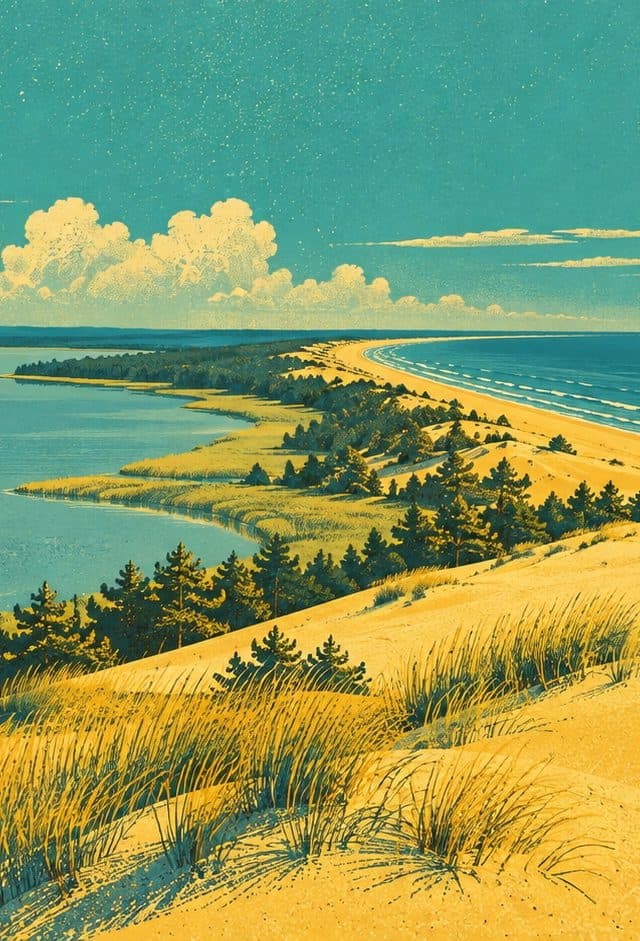
If you only ride one stretch, ride this one. The Curonian Spit is a UNESCO-listed sand spit between the lagoon and the open Baltic, and the Lithuanian half carries a dedicated cycle path of about 50 km from Smiltynė to Nida, through Juodkrantė, Pervalka and Preila.
The path was rebuilt and officially reopened in September 2024. It is 2.5 to 3.5 metres wide, almost flat, and for most of its length separated from road traffic. It runs mostly through pine forest, with the dunes and the lagoon appearing between the trees.
You reach Smiltynė on the short ferry from Klaipėda, which carries bikes. Nida is the natural end point, with the Parnidis dune, the lagoon front and the road to the Russian border a few kilometres south, where you turn back.
Our self-guided Curonian Spit by bike tour is built around this path: seven nights from Klaipėda, down the spit to Nida, a boat across the lagoon to Ventė Cape, then the Nemunas delta and the coast north to Palanga. The bike, the luggage moves and the ferries are included. It is the only trip we sell where we provide the bikes.
Latvia's coast and the Estonian islands
In Latvia the route runs north from the Lithuanian border through Liepāja, Pāvilosta and Ventspils to Cape Kolka, where the open sea meets the Gulf of Riga, then down the gulf shore through Jūrmala to Riga. The western coast is the wildest part: long empty beaches, fishing villages and forest gravel roads. It is also where the route uses stretches of public road.
Estonia's coast section is close to a thousand kilometres from the Latvian border to Narva, in six sections. It is the longest of the three and the most varied: cycle paths near the towns, quiet paved roads, some gravel, and short unavoidable stretches of main road.
The islands are the reason most people come. From Virtsu a ferry crosses to Muhu, which is joined to Saaremaa by a causeway, and a full loop of Saaremaa is around 280 km. A second ferry from Triigi on Saaremaa to Sõru on Hiiumaa lets you continue north without going back to the mainland. Traffic is light, the villages are small, and the windmills, junipers and stone walls are what Estonia looks like on a postcard.
Terrain, surfaces and when to go
The region is flat. There is no serious climbing anywhere on the coast, and the hardest thing you will meet is a headwind off the sea, which on an exposed stretch can make thirty kilometres feel like sixty. Plan your direction with the prevailing wind in mind and keep spare time in the day.
Surfaces are the real variable. The best paths are smooth asphalt; between them you will ride compacted gravel, forest tracks and occasional sand. A hybrid, trekking or gravel bike with tyres of 35 mm or wider is the comfortable choice. A narrow-tyred road bike will spend a lot of time on the main road.
The season is May to September. June brings the longest days, with light until close to midnight in Estonia, and the quietest paths before the school holidays. July and August are warmest and busiest on the coast. September is calm and golden but the days shorten quickly, and from October the guesthouses and seasonal cafes on the islands and the spit start to close. Bring insect repellent for the forest stretches in early summer.
Bikes on trains and ferries
Trains are useful for skipping inland stretches, and each country has its own rules.
Lithuania (LTG Link): bikes travel in second and third class only, never first, one per passenger, with a surcharge of 45% of the full fare. Each train has at least four bike places. The bike must be under 25 kg and within 185 x 110 x 60 cm, and e-bikes are allowed up to 250 W. A folded, packed bike within the hand-luggage limit travels free.
Latvia (Vivi): you buy a baggage ticket for the bike, online, in the Vivi app, at the station or from the conductor. Carriages with bike racks are marked with a sticker on the door. Groups of more than 15 cyclists must register 48 hours ahead.
Estonia (Elron): there are bike places in a marked area of each train. In the main season a bike ticket is required, priced at half the passenger fare with a one-euro minimum, and a few places can be reserved in advance online. Elron has changed this rule several times since 2022, including free winter periods, so check elron.ee before you plan around it. Estonia's island ferries carry bikes on a small bicycle ticket, bought online at praamid.ee or from the machines at the port.
Sleeping out: what the rules actually allow
The three countries are not the same, and the Scandinavian idea of a universal right to roam only partly applies.
Estonia is the most open. You may camp for up to 24 hours on private land that is neither fenced nor marked, out of sight and hearing of any house, and the state forest agency RMK runs a network of free forest campsites with fire rings and dry toilets. Fires are allowed only where the landowner permits, in practice at those sites.
In Latvia you may camp in state and municipal forests outside protected areas without asking, but private land needs the owner's consent, and protected areas, marked by a green sign with an oak leaf, have their own restrictions. Beach and dune rules vary by municipality, so do not assume the sand is fair game.
Lithuania is the strictest. The official tourism board guidance is that overnight stays in a tent are allowed only at designated campsites, and camping is banned outright in reserves, border zones and military areas. On the Curonian Spit, which is a national park, sleep indoors or at a campsite.
Hire, safety and the small things
Bike hire is easy to find in the obvious places, such as Neringa on the Curonian Spit, and much harder in between. For a long linear route, bringing your own bike or booking a trip that includes one is simpler than renting locally and returning it.
In Lithuania a helmet is compulsory for riders under 18 and recommended for adults. On the road, Lithuanian law also requires a reflective vest or lights by day, and both lights and a reflective vest in darkness or poor visibility. It is a sensible standard across all three countries.
Rural traffic is light but fast, so where a separate path exists, use it. Carry water and food on the island and Courland stretches, where villages with a shop can be far apart.
- Is the Baltic region good for cycling?
- Yes, especially for relaxed touring. The terrain is flat, traffic in the countryside is light and the coast is followed by EuroVelo 10 almost the whole way. The trade-off is surface quality: expect gravel and forest roads between the best paths.
- What is the best cycling route in the Baltics?
- For most riders, the Curonian Spit path in Lithuania: about 50 km from Smiltynė to Nida, almost flat, rebuilt in 2024 and largely separated from traffic. For a longer trip, the Estonian islands of Muhu, Saaremaa and Hiiumaa are the other standout.
- Can I take a bike on trains in Lithuania, Latvia and Estonia?
- Yes, in all three, with a bike ticket. LTG Link in Lithuania charges 45% of the full fare and does not allow bikes in first class. Vivi in Latvia sells a baggage ticket for the bike. Elron in Estonia charges half the passenger fare in season. Rules change, so check with the operator before you travel.
- Is wild camping allowed in the Baltic states?
- It depends on the country. Estonia allows camping for up to 24 hours on unfenced, unmarked land and has many free RMK forest campsites. Latvia allows camping in state and municipal forests outside protected areas. Lithuania officially allows tents only at designated campsites.
- When is the best time for a cycling holiday in the Baltics?
- May to September. June has the longest days and quiet paths, July and August are warmest and busiest, and September is calm but shorter. From October many seasonal places on the coast and islands close.
Make this part of your Lithuania trip.
Tell us your dates, interests and the pace you have in mind. We will suggest how this could fit your route.