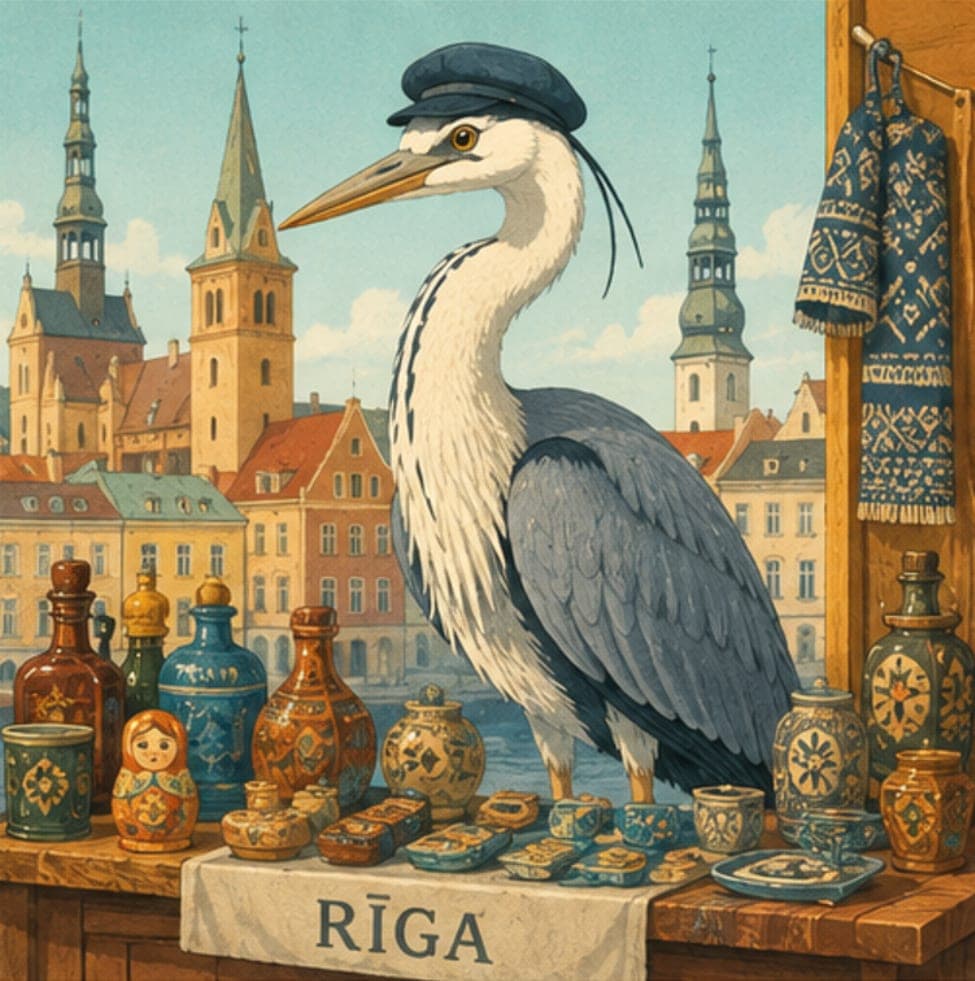
The capital: Riga
Latvia's capital is Riga, home to around 592,000 people. It sits on the Daugava river near the coast, and it has been the region's commercial and cultural centre for centuries.
Riga is best known as the Art Nouveau capital of Europe. The centre holds more than 750 Jugendstil buildings, roughly a third of all the buildings in central Riga, the densest concentration of the style anywhere in the world. The finest stretch runs along Alberta iela, where the facades carry masks, faces and mythological figures. The old town and the boulevard ring around it are a UNESCO World Heritage site.
The landscape: forest, coast, and no mountains
Latvia is flat to gently rolling, not mountainous. The country has no mountains at all: its highest point, Gaiziņkalns in the Vidzeme uplands, reaches just 312 metres, closer to a large hill than a peak. If you are looking for alpine scenery, this is not the place. What Latvia offers instead is forest and water.
About 53 percent of the country is forest, which makes it one of the greenest countries in the European Union. The Baltic coastline runs for 498 km, from wide sand beaches to quiet pine-backed shores. The Daugava, the country's main river, crosses it from the southeast and reaches the sea at Riga. Wildlife is genuinely present: lynx, elk, beaver and hundreds of bird species live in the woods and wetlands.
The four regions
Latvia divides into four historic regions. Vidzeme, in the northeast, holds the Gauja valley, often called Latvian Switzerland, with the resort town of Sigulda, the medieval town of Cēsis, and Gauja National Park, the oldest and largest national park in the country.
Kurzeme is the wild west, a long, thinly populated coast of fishing villages and empty beaches. Zemgale, the fertile plain south of Riga, is home to Rundāle Palace, the baroque residence often called the Baltic Versailles. Latgale, in the east, is the lake district, a Catholic and multilingual corner centred on the pilgrimage basilica of Aglona and the quietest travel in the country.
The cities and port towns
After Riga, the largest city is Daugavpils in the southeast, near the Lithuanian and Belarusian borders. The other cities worth knowing are Liepāja and Ventspils on the west coast, Jelgava on the Zemgale plain, and the smaller destinations of Sigulda and Cēsis in the Gauja valley. Jūrmala, a string of wooden-villa beach resorts twenty minutes from Riga, is the classic Baltic seaside town.
Latvia's port cities, its Hafenstädte, are Riga, Ventspils and Liepāja, all of them ice-free Baltic ports that stay open through the winter. Ventspils and Liepāja are working harbours with beaches attached, and Liepāja carries a distinct maritime and military-history character from its former naval base.
What Latvia is known for
Latvia is known first for Art Nouveau Riga, and then for its forests and wildlife. It is also known for amber, the fossil resin washed up along the Baltic shore and worked here for centuries, and for the belle-époque beaches of Jūrmala.
Culturally, the country is defined by the Song and Dance Festival, a mass choral gathering recognised by UNESCO as intangible cultural heritage, where tens of thousands sing together. Rundāle Palace is the great architectural set piece outside the capital. And Latvia holds a place in recent history through the Baltic Way, the 1989 human chain that linked Vilnius, Riga and Tallinn in a single line across the three countries.
The best time to visit
The best time to visit Latvia is late May to September. This is the warm half of the year, when the coast is open, the forests are green and the days are long. June brings the longest days of all, close to white nights, with light in the sky until well past midnight.
December is the other window, for Riga's Christmas market on the old-town square. Riga claims the first decorated Christmas tree, raised on Town Hall Square in 1510, and leans into the story every winter. Outside these two windows, the shoulder months of April and October are quieter and cheaper, with cooler, greyer weather.
- What is the capital of Latvia?
- The capital of Latvia is Riga. It is the largest city in Latvia, with about 592,000 people, and it is known as the Art Nouveau capital of Europe.
- What is Latvia known for?
- Latvia is known for the Art Nouveau architecture of Riga, its dense forests and wildlife, amber, the Jūrmala beaches, Rundāle Palace, and the Song and Dance Festival, a UNESCO-recognised choral tradition.
- Does Latvia have mountains?
- No. Latvia has no mountains. It is a low, flat to gently rolling country, and its highest point, Gaiziņkalns, reaches only 312 metres. The landscape is defined by forest and coast, not peaks.
- Which cities should you visit in Latvia?
- Riga first, then Jūrmala by the sea, Sigulda and Cēsis in the Gauja valley, and the west-coast ports of Liepāja and Ventspils. Daugavpils in the east is the second-largest city.
- What is the landscape of Latvia like?
- Low and green. About 53 percent of Latvia is forest, one of the highest shares in the European Union, with 498 km of Baltic coastline and the Daugava river. There are lakes in the east and no mountains anywhere.
- When is the best time to visit Latvia?
- Late May to September for the long days and open coast, with June the lightest month, close to white nights. December is the time for Riga's Christmas market.
Still have a question?
Ask the small team that runs these trips. A real person replies, usually within one working day.