
The route at a glance
Vilnius, Trakai, Kaunas, the Curonian Spit, the Hill of Crosses, Rundāle Palace, Riga, the Gauja valley, Pärnu, Haapsalu, Tallinn. It reads like a list, but on the map it is one clean line west to the sea and then north.
The table on this page has each driving day with its distance and time. The pattern is deliberate: a short first drive to get used to the car, a day off after each long one, and the car parked in every city.
One way beats a loop. A loop back to Vilnius adds about 600 km of road you have already seen. A one-way rental carries a drop-off fee, and it is almost always worth paying.
Days 1 to 3: Vilnius, Trakai and Kaunas
Arrive in Vilnius and do not collect a car. The old town is walkable and parking inside it is deliberately difficult, so the first two days are on foot: the university courtyards, the Gate of Dawn, Užupis across the river.
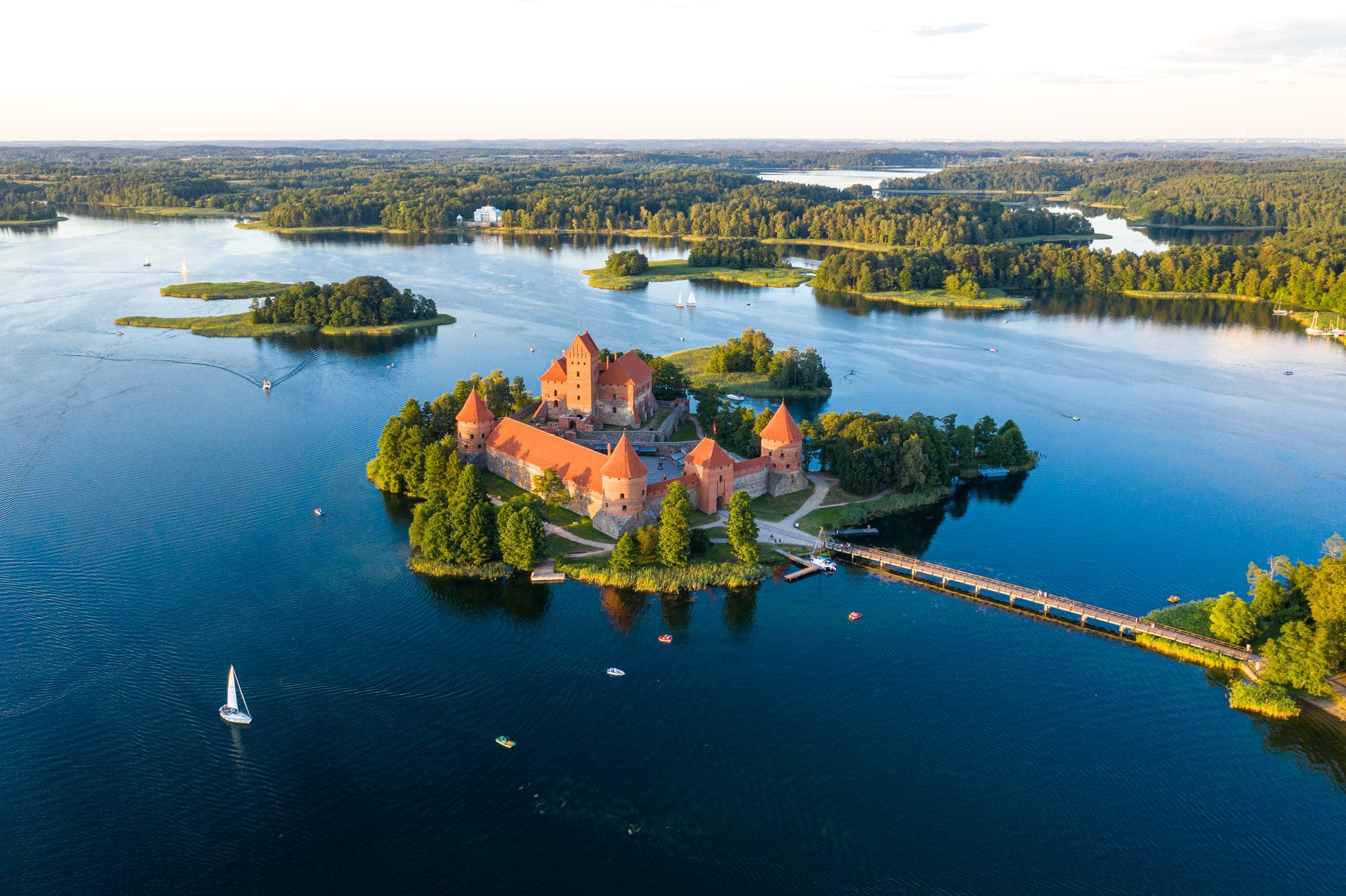
On day three take the car and drive half an hour west to Trakai, where a brick castle stands on an island in a lake. Then on to Kaunas for the night, 130 km and about two hours in all, on dual carriageway after Trakai. It is an easy first day on purpose.
Kaunas was Lithuania's capital between the wars and has the modernist centre to show for it. An evening is enough to walk Laisvės alėja and find dinner.
Days 4 and 5: west to the Curonian Spit
Day four is 270 km and about three and a half hours: motorway to the port of Klaipėda, then the vehicle ferry to Smiltynė. Cars cross from the New Ferry Terminal on the south side of the city, about every 20 minutes through the day, and the crossing takes a few minutes.
At the Alksnynė control post you pay the entry fee to Neringa: €10 for a passenger car, €50 from 20 June to 20 August. It can be paid online in advance. From there the road runs about 45 km through pine and dune to Nida.
Day five the car stays at the hotel. Walk up the Parnidis dune before nine, cycle the lagoon path 20 km north to Juodkrantė and the Hill of Witches, and eat smoked fish when you get there.
Day 6: the long one, to Riga
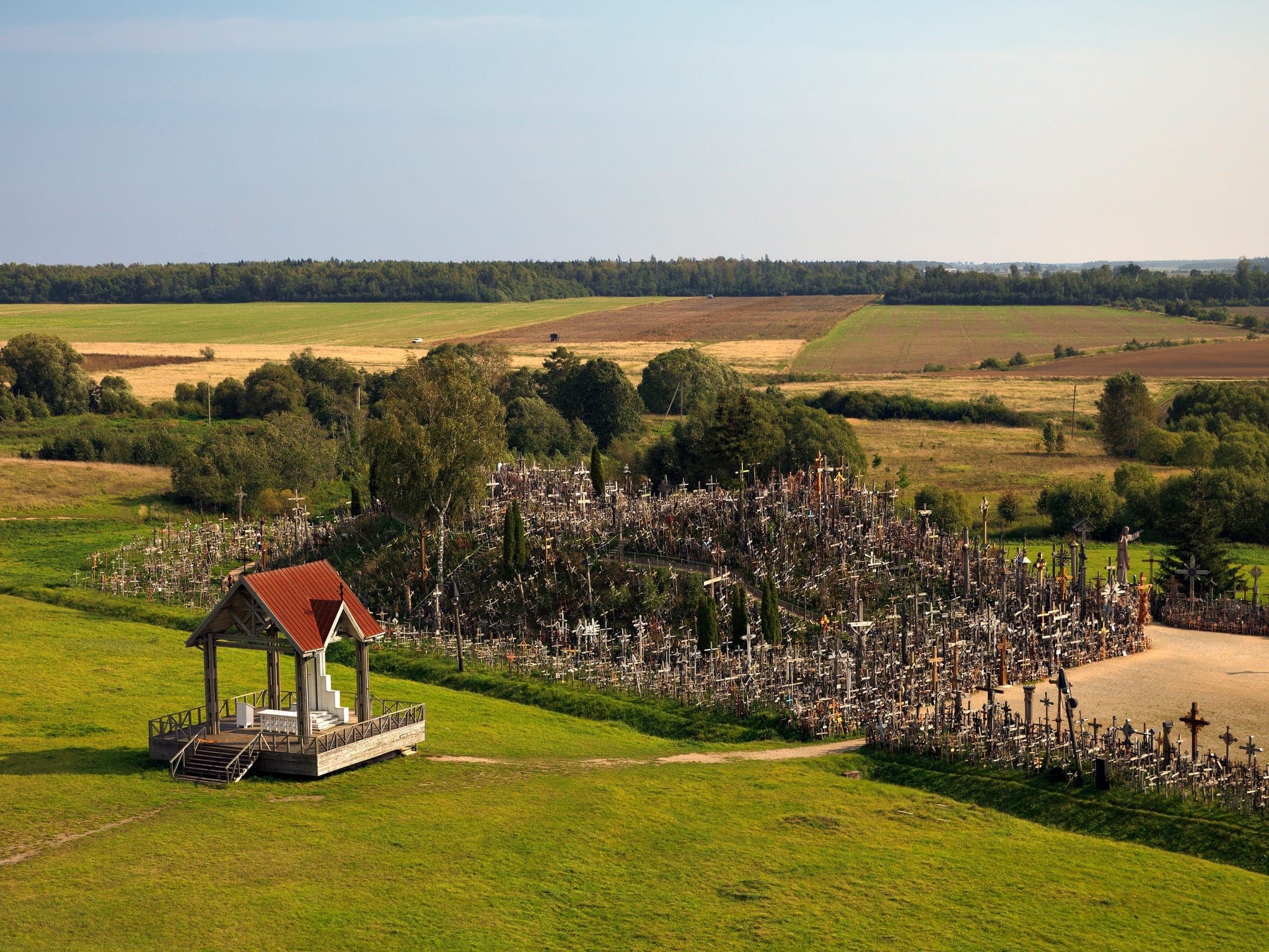
This is the one demanding day: about 380 km and five and a half hours of driving, so leave early. Take the ferry back to the mainland and drive north to the Hill of Crosses near Šiauliai, a mound covered in well over a hundred thousand crosses.
The Latvian border is a sign at the side of the road. Nobody stops you. Half an hour beyond it is Rundāle Palace, a baroque palace standing alone in farmland, and the right place for a late lunch and a walk through the rooms.
You reach Riga in the early evening. Park at the hotel and leave the car there for the whole of the next day.
Days 7 and 8: Riga, then the Gauja valley to Pärnu
Day seven is Riga on foot: the Art Nouveau district on Alberta iela in the morning, the Central Market in its five zeppelin hangars at lunch, the Old Town in the afternoon. The beach at Jūrmala is half an hour by train if you would rather swim.
Day eight is 330 km and about four and a half hours, with the best scenery of the trip in the first half. Drive northeast into Gauja National Park for Turaida's red castle above the river at Sigulda, then Cēsis, where you take a candle lantern down into the castle cellars.
From Cēsis the road runs northwest to the Estonian border, again unmanned, and on to Pärnu, Estonia's summer town, for the night.
Days 9 and 10: the coast road to Tallinn
Take a slow morning in Pärnu, on the beach if the weather allows. Then ignore the main road and take the coast road north, 220 km and about three hours.
It runs through Haapsalu, a small spa town with a ruined bishop's castle and a railway station whose platform is over 200 metres long, built to receive the imperial train. It is the last quiet stop before the capital.
Drop the car when you arrive in Tallinn. Day ten is the walled Old Town on foot: Town Hall Square, the Patkuli viewpoint on Toompea, and Kalamaja's wooden houses if your flight is late.
Renting the car: one-way fees and borders
Rentals are straightforward in all three capitals. An EU or international licence is accepted and most companies rent to drivers aged 21 and over.
Two things to check on the agreement before you sign. First, that the car may be driven in all three Baltic states: most allow it, some restrict travel outside the country of hire. Second, the one-way fee for collecting in Vilnius and returning in Tallinn, which varies widely between companies and is the number that most changes the total.
Taking a rental into Russia or Belarus is not permitted. The route never needs to: the closest it comes is Nida, where the road ends at a closed checkpoint.
Roads, fuel, parking and winter
The main north to south road is the Via Baltica, the E67, mostly two lanes and in good condition. Traffic outside the cities is light. Off the main roads you will meet the occasional gravel stretch in the countryside, which is normal and fine at lower speed.
There are no motorway toll booths for cars in any of the three countries, and fuel is priced at ordinary European levels. In the cities, park in the marked zones and pay by app or machine. All three old towns are largely closed to traffic.
From November to March this is a different trip. Winter tyres are mandatory and fitted to every rental, but snow, ice and a sunset around half past three make rural drives slow. The Curonian Spit is largely shut. In winter we suggest the capitals with a driver rather than this route by rental car.
Coming from Germany with your own car
You have two ways in. Overnight car ferries run from Kiel to Klaipėda and from Travemünde to Liepāja on the Latvian coast, which puts you on the Baltic shore without the drive across Poland.
Or you drive: across Poland and through the Suwałki corridor into Lithuania, a full day and a half from Berlin for most people. Break it in Warsaw or the Masurian lakes.
With your own car the one-way question disappears, so the route becomes a loop. Arrive by ferry at Klaipėda, drive this itinerary from the Curonian Spit onwards, and return south from Tallinn through Tartu and Vilnius, or take the ferry home from Liepāja.
The same route, already booked
Our Baltic capitals self-drive is this itinerary with the work done: hotels on all nine nights, the car delivered to your Vilnius hotel on day three with the paperwork done there, the ferry and the timed entries at Trakai and Rundāle reserved, and a route book written by the people who drive it.
You drive, we carry the planning, and there is a person on the phone if something goes wrong.
If you like the route but not the driving, the same road with a private driver-guide is The Three Crowns.
| Day 3: Vilnius to Kaunas | 130 km, about 2 h | Via Trakai |
|---|---|---|
| Day 4: Kaunas to Nida | 270 km, about 3 h 30 | Vehicle ferry at Klaipėda |
| Day 6: Nida to Riga | 380 km, about 5 h 30 | Hill of Crosses and Rundāle |
| Day 8: Riga to Pärnu | 330 km, about 4 h 30 | Sigulda and Cēsis |
| Day 9: Pärnu to Tallinn | 220 km, about 3 h | Coast road via Haapsalu |
| Total | About 1,330 km | Around 1,400 km with detours |
- How many days do you need for a Baltic road trip?
- Ten days is the comfortable length for Vilnius to Tallinn with the Curonian Spit and the Gauja valley. Seven days covers the three capitals by the direct road. Fourteen lets you add Saaremaa island.
- Can you drive a rental car between Lithuania, Latvia and Estonia?
- Usually yes. Most rental companies allow all three Baltic states, and the borders are open with no checks. Confirm it on the rental agreement, and expect a drop-off fee if you return the car in a different country.
- Are there road tolls or vignettes in the Baltics?
- Not for passenger cars. There are no motorway toll booths in Lithuania, Latvia or Estonia. The one fee on this route is the entry to the Curonian Spit: €10 per car, €50 from 20 June to 20 August.
- Is driving in the Baltics difficult?
- No. Roads are in good condition, traffic outside the cities is light and signage is clear. The demanding part is winter, from November to March, when snow, ice and short daylight slow everything down.
- Which direction is best, Vilnius to Tallinn or Tallinn to Vilnius?
- North, from Vilnius to Tallinn. The long drives fall in the first week, the scenery builds towards the Estonian coast, and Tallinn is the easiest capital to fly home from or to continue to Helsinki.
Not sure how to shape the trip?
Tell us your dates and what you would like to see. We will draft a route that fits, usually within one working day.