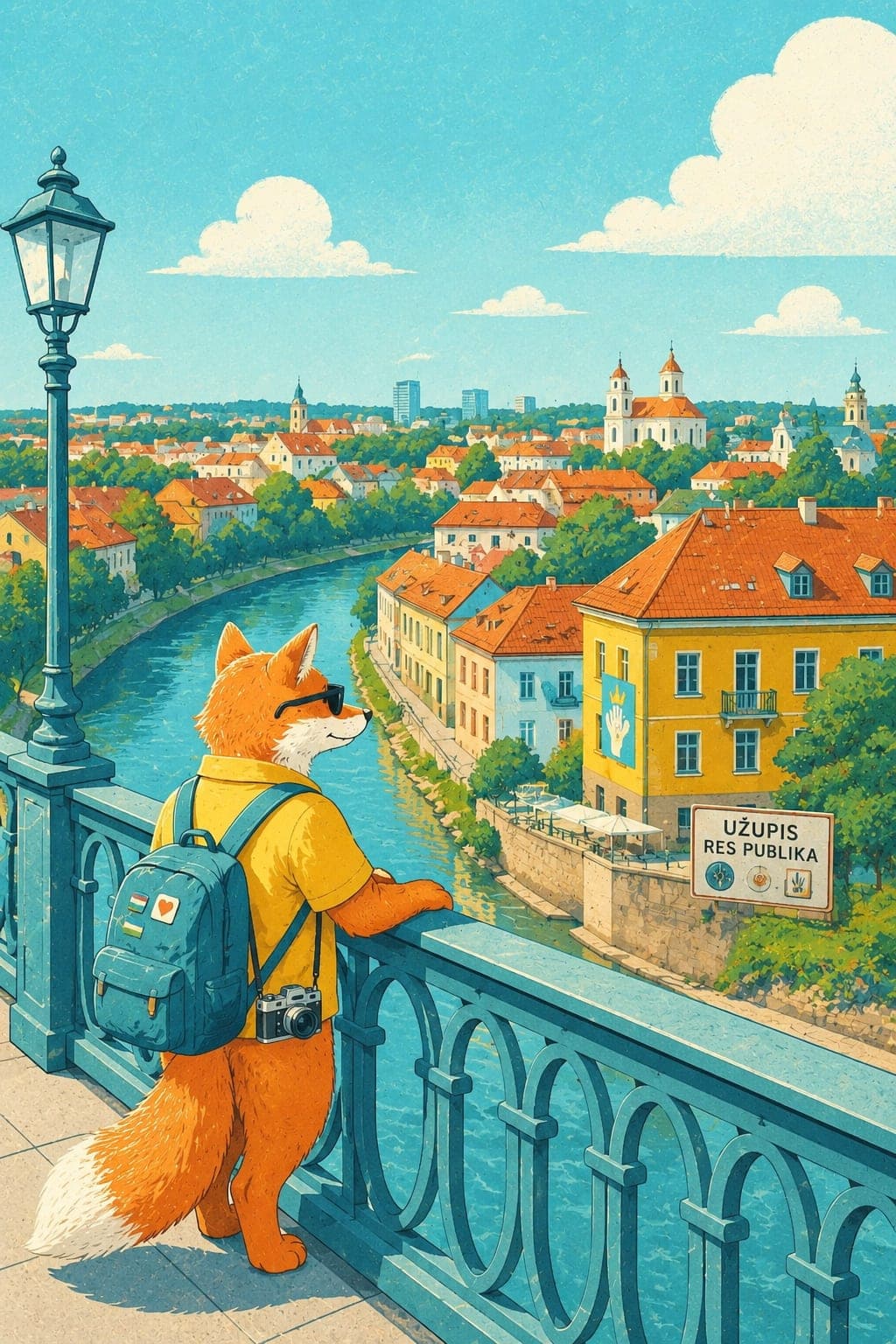
The short answer
Lithuania is safe. It sits in the same bracket as Portugal or Poland on most international crime and safety indices, and well above the European average for how comfortable people feel walking alone after dark. For a visitor the practical concerns are the same as any European city: keep your phone out of a back pocket, book your car rather than flagging one down, and take winter driving seriously.
Nothing about the country calls for special precautions beyond that. Tens of thousands of visitors come every year, including a large number of solo travellers, and the overwhelming majority never have an incident of any kind.
Crime, and where the pickpockets actually are
Violent crime is uncommon and very rarely touches tourists. What does happen is petty theft, and it concentrates in a small number of predictable places: Pilies and Ausros Vartu streets in Vilnius old town on a busy afternoon, the Halles market, the bus and train station area just south of the old town, and any crowded terrace during a summer festival.
The station district is the one part of central Vilnius locals will tell you to pay attention to at night. It has improved a great deal in the last decade and is nothing like a dangerous neighbourhood, but it is scruffier than the old town and worth walking through with your wits about you rather than lingering in.
The other thing to know is the taxi question. Use Bolt or a taxi you have booked. Cars waiting outside nightlife venues and at the airport arrivals door without a booking are where the overcharging happens. It is an annoyance rather than a danger, and it is entirely avoidable.
The Belarus border and the Suwalki gap
This is the part people are really asking about, so here it is plainly. Vilnius sits about thirty kilometres from the Belarusian border, which is closer than most visitors expect. The border is closed to ordinary crossings and heavily monitored, and it makes no practical difference to a visit: the city goes about its business, flights land, restaurants are full, and nothing about the day feels like a frontier.
The Suwalki gap is the other phrase that turns up in the news. It is the roughly sixty-five kilometre stretch of the Lithuanian and Polish border, between Belarus on one side and the Russian exclave of Kaliningrad on the other. It is strategically important on a map in a briefing room. On the ground it is farmland, forest and a quiet motorway, and people drive it to Warsaw every day without a thought.
Lithuania is a full NATO member with allied troops permanently stationed in the country, including a substantial German brigade. Whatever you make of the geopolitics, the practical position is that the country is defended, calm, and open for business.
The war in Ukraine, in kilometres
Lithuania does not border Ukraine, and the nearest fighting is more than a thousand kilometres from Vilnius. That is roughly the distance from London to Milan. Air travel is normal, hotels are open, and daily life carries on without disruption.
Lithuania has taken in a large number of Ukrainian refugees, so you will hear Ukrainian on the streets and see flags in windows. That is the most visible sign of the war you are likely to encounter.
If the situation ever changed, your own government's travel advisory would say so before anyone else. It is worth a glance before any trip, to Lithuania or anywhere.
Health, water, roads and the practical bits
Healthcare is good and pharmacies, marked vaistine, are easy to find in every town. Tap water is safe to drink throughout the country. The single emergency number is 112, and operators speak English. No vaccinations are required for a visit.
Roads are in good condition and the motorways are genuinely fast. The two things worth respecting are winter and wildlife. From November to March the roads can be icy and the light is short, and outside the cities elk and deer cross the road at dusk in real numbers. Both are reasons a lot of visitors prefer to leave the driving to someone who does it year round.
One rule catches people out: headlights are required at all times, day and night, in every season. Hire cars usually handle this automatically, but check.
Solo travellers, women, and travelling as a family
Solo travellers, including women, generally report feeling comfortable in Lithuania. Vilnius is well lit, compact and busy in the evening, and locals are used to visitors. The usual sense applies, as it would in any city, but there is nothing about Lithuania that argues against a solo trip.
It is also an easy country for families. Cities are small enough to walk, restaurants are relaxed about children, and the distances between things are short. Užupis, Trakai and the Curonian Spit all work well with children in tow.
Lithuania is broadly welcoming, though it is a more socially conservative country than Sweden or the Netherlands. Same-sex couples are safe here and Vilnius in particular is relaxed, but public affection draws more attention outside the capital than it would further west.
How a private trip handles all of this
Most of what is on this page stops being your problem when someone local is driving. No unlicensed taxis, no wondering which street to avoid at eleven at night, no first winter drive on an unfamiliar road, and someone to call who is in the same time zone.
That is not a reason to book a tour, and Lithuania is perfectly manageable independently. It is just what the difference actually is.
- Is Lithuania safe for tourists right now?
- Yes. Lithuania is calm, fully open and operating normally. It is an EU and NATO member with low violent crime, and the nearest fighting in Ukraine is more than a thousand kilometres away. Flights, hotels and tours all run as usual.
- Is Vilnius safe at night?
- Yes. The old town and the centre are well lit and busy into the evening, and walking back to a hotel is normal. The area around the bus and train stations is the scruffiest part of the centre and is better crossed than lingered in after dark.
- How close is Vilnius to the Belarus border?
- About thirty kilometres. The border is closed to ordinary crossings and closely monitored, and it has no practical effect on a visit. Vilnius is one of the few European capitals this close to a national border, which is a quirk of history rather than a warning.
- What is the Suwalki gap and should I worry about it?
- It is the roughly sixty-five kilometre corridor along the Lithuanian and Polish border, between Belarus and the Russian exclave of Kaliningrad. It matters to military planners. To a traveller it is a quiet stretch of farmland and motorway on the drive to Poland.
- Is Lithuania safe for solo female travellers?
- Yes. Solo travellers, including women, generally report feeling comfortable here. The cities are compact, well lit and walkable at night, and locals are used to visitors. Ordinary city sense is all that is needed.
- Can you drink the tap water in Lithuania?
- Yes. Tap water is safe to drink across the country and in most places it is genuinely good. Bottled water is not necessary.
- Do I need any vaccinations for Lithuania?
- No vaccinations are required. If you plan a lot of hiking in forest between spring and autumn, tick-borne encephalitis vaccination is worth discussing with your doctor, as ticks are present in the woods. For a city and coast trip it is not a consideration.
- Is Lithuania safe from Russia?
- Lithuania borders the Russian exclave of Kaliningrad and is a full member of NATO, with allied troops permanently stationed in the country. There is no fighting on Lithuanian soil, the border is quiet, and Vilnius, Kaunas and Klaipeda go about their business normally. For a traveller the answer is yes.
- Is it safe to travel to Lithuania because of the war in Ukraine?
- Yes. Lithuania does not border Ukraine, and the nearest fighting is more than a thousand kilometres from Vilnius, roughly the distance from London to Milan. Flights land normally, hotels are open and daily life is undisrupted. The most visible sign of the war you are likely to meet is Ukrainian spoken on the street and flags in windows.
- Is Lithuania dangerous?
- No. Lithuania sits in the same bracket as Portugal or Poland on most international crime and safety indices, and violent crime very rarely involves visitors. The realistic concerns are pickpocketing in the busiest parts of Vilnius old town, unbooked taxis, and winter roads.
- Is Vilnius safe?
- Yes. The old town and the centre are comfortable to walk by day and in the evening, and locals are long used to visitors. Petty theft concentrates on Pilies and Ausros Vartu streets on a busy afternoon and around the Halles market. The station district south of the old town is scruffier than the rest and is better crossed than lingered in at night.
- Is Kaunas safe?
- Yes. Kaunas carries the same low level of risk as Vilnius, and the old town and Laisves aleja stay busy into the evening. Ordinary city sense is all it asks of you.
Still weighing up whether to go?
Ask someone who lives and guides here. You will get a straight, current answer, usually within one working day.